


 info@due-all.com
 Open 24/7

What Commercial HVAC Maintenance Actually Costs in Arizona
Straight answer, real ranges, and exactly what changes the number. No form required to see it. Almost every contractor site in this market sends you to a contact form before it will say anything about money. You should not have to trade your phone number for a ballpark.
Here is what commercial maintenance agreements run in Arizona according to published industry data. Published 2026 municipal bid tabulations put routine maintenance at $173 to $267 per unit per visit, with labor billed at $95 to $140 per hour. Annually, a small retail space or single suite with one or two units typically lands between $500 and $1,200 per year. A multi-suite office or a large restaurant with two to five units generally runs $1,500 to $3,500 per year. An office building or warehouse with five or more units usually starts around $3,000 and climbs past $5,000.
Those are industry ranges, not Due-All quotes. What your building costs depends on what is actually sitting on your roof, which is why we put a fixed price per unit in writing after we have walked the site. Call and describe the property and we will tell you on the phone roughly where something like yours lands, before anybody schedules anything.
Call Now: (480) 988-0070

Serving East Valley businesses since 1989. ROC #140358, licensed, bonded and insured.
Get a Fixed Per-Unit Price
Tell us what you have and we will schedule a free site walk. No charge, no obligation, and you keep the written scope either way.

What Drives a Commercial Maintenance Price Up or Down
Two buildings on the same street can be a thousand dollars a year apart, and the difference is almost never the contractor's markup. It is the equipment, the access and the number of sites. Here is what we are actually counting when we build a price, so you can work out for yourself roughly where your building sits before you ever call anyone.
Unit Count and Equipment Type: The biggest single factor is how many pieces of equipment we are touching and what kind they are. Packaged rooftop units and split systems take different amounts of time, different parts and different access. Published industry data puts an individual rooftop unit at roughly $500 to $1,500 per year on its own, with each additional unit adding somewhere around $300 to $800 per year. That is why unit count moves the total faster than anything else on this list.
Tonnage, Filters and Roof Access: A twenty ton unit is not twice the work of a ten ton unit, but it is not the same work either. Filter size and filter count matter more than most owners expect. Filters are a consumable, and we suggest filters be changed on their own schedule of between a 30 to 60 day cycle rather than only during quarterly services, because Arizona dust loads them faster than national guidance assumes. Access is the quiet one. A permanent roof ladder and a clear walkway is a very different job from a unit that needs a lift rental every time we come out.
Number of Buildings and Drive Time: One building with six units prices differently from six buildings with one unit each, because drive time between sites is real time on the clock. After-hours emergency calls are not part of the agreement price. If you need one, it is billed at an after-hours rate.

None of those are judgement calls made from an office chair. They are things we count on site with a clipboard, which is the entire reason a real number comes after a walk rather than before it.
Get a Fixed Per-Unit Price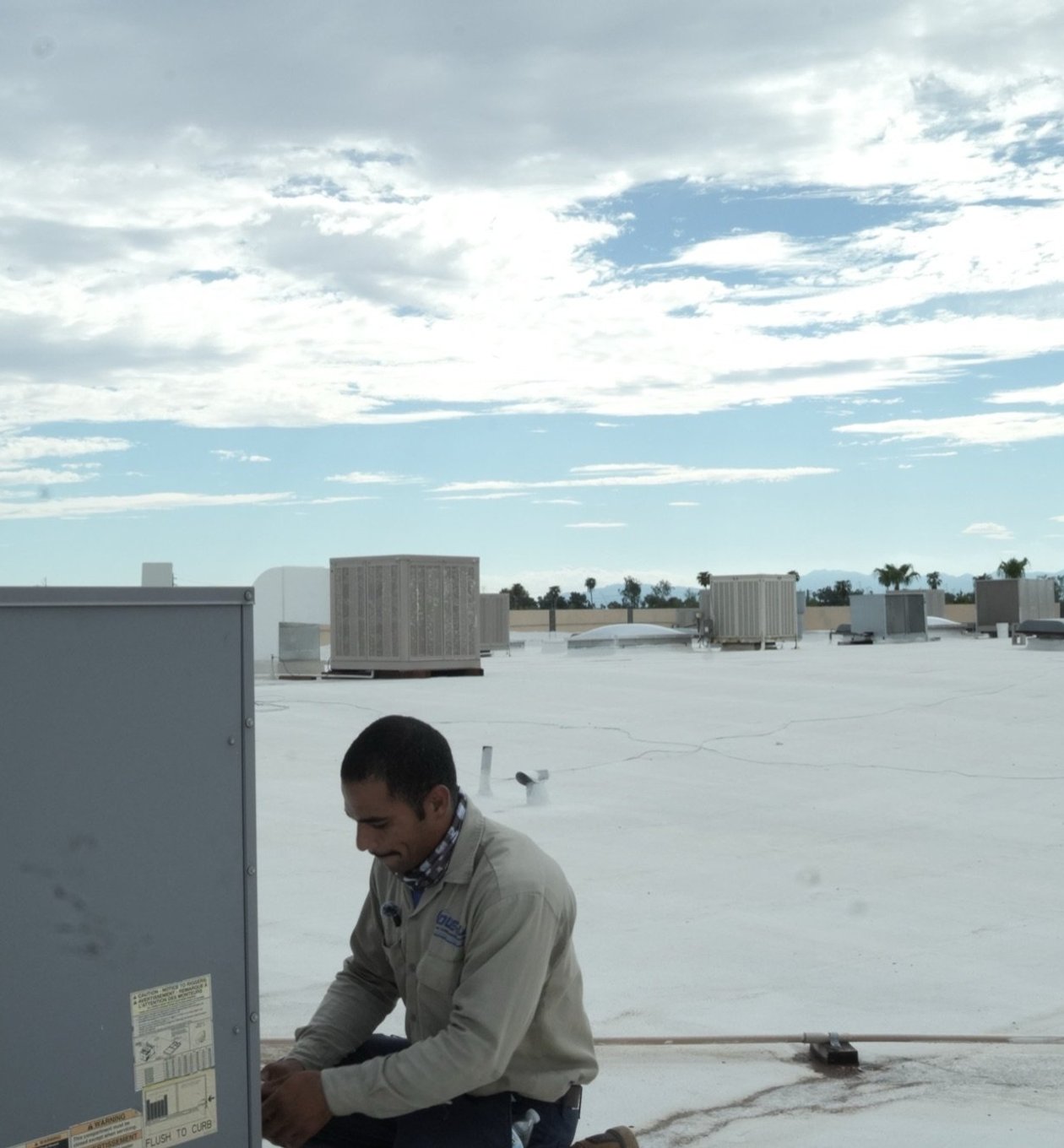
What Your Maintenance Agreement Covers
Most maintenance plans you will see advertised are sold on how many visits you get. That is the wrong thing to compare, because a visit is not a unit of value. What separates a cheap agreement from a good one is what actually gets done on that visit, and what happens when something is found wrong. Our agreement covers inspection and service. Parts and repairs are quoted separately, because the cost of parts varies too much from one unit to the next to build into a fixed agreement price.
Inspection and Service: Scheduled inspections, filter checks, coil cleaning, condensate service, belts and motors, refrigerant and electrical checks, controls verified, and a written report after every visit that you can forward to an owner or attach to a work order. On a newer building still under warranty, that report is also the documentation the manufacturer asks for.
Parts and Repairs Quoted Separately: Parts are not bundled into the agreement, because what a part costs depends on the unit, the brand and what failed. When a visit turns up something that needs a part or a repair, it is listed separately on the report and quoted before any work is done, so it reaches you as a decision rather than a surprise on an invoice.
Why We Quote After a Site Walk
We will not price equipment we have not seen. That is not a stalling tactic, it is the only way to hand you a number that is still true in month eight. A photo does not tell us the age of a compressor, whether the condensate line has been rerouted by three previous contractors, how many filters a unit actually takes, or whether the roof needs a lift to reach at all. A contractor who quotes without looking is either padding the price to cover the unknown or is going to come back and renegotiate.
So the process is short and it costs you nothing. We walk the property, inventory every piece of equipment with model and serial numbers, note access and filter sizes, and hand you a written scope with a fixed price per unit. You keep that document whether you hire us or not. An accurate equipment inventory is a useful thing for a building to own even if you take it to somebody else.
And if you would rather have a rough figure before anyone visits, just call and describe the building. We will tell you on the phone where something like yours usually lands using the ranges at the top of this page. Nobody should have to sit through a site visit to find out whether a contractor is in their budget.
Get a Fixed Per-Unit Price After a Free Site Walk
Commercial HVAC Maintenance Pricing Questions
It depends on how many units you have and what they are, but real ranges do exist. Published industry figures put a small retail space or single suite with one or two units at roughly $500 to $1,200 per year, a multi-suite office or large restaurant with two to five units at about $1,500 to $3,500 per year, and an office building or warehouse with five or more units at $3,000 to $5,000 and up. Those are market ranges rather than Due-All quotes. Your actual figure is the per-unit price we put in writing after walking the building.
Five units usually lands a building at the top of the mid range or the bottom of the large range. Published industry data prices individual rooftop units at roughly $500 to $1,500 per year each, with every additional unit adding somewhere around $300 to $800 per year. Published 2026 municipal bid tabulations show routine maintenance at $173 to $267 per unit per visit, which works out inside those annual ranges on a regular service cadence. The spread comes down to tonnage, filter sizes, roof access and how many sites the units are spread across.
Commercial equipment genuinely varies, and a contractor who publishes one flat number will either lose money on the hard buildings or overcharge on the easy ones. Publishing also shows competitors exactly where a company sits. And when no price is published, a buyer has to make contact before learning anything, which leaves the contractor leading the conversation from the start. We would rather you have the information up front, so we publish the ranges, explain what moves them, and price your specific building after we have seen it.
Inspection and service: scheduled inspections, filter checks, coil cleaning, condensate line service, belt and motor checks, refrigerant and electrical inspection, control and thermostat verification, and a written report after every visit that you can forward to an owner or attach to a work order. Parts and repairs are quoted separately, because parts costs vary too much from one unit to the next to build into the agreement price. After-hours emergency calls are not included and are billed at an after-hours rate. The full scope is written down before you sign, so nothing about what is covered is left to interpretation.
The agreement covers inspection and service. Repairs and parts found during a visit are quoted separately, before any work is done, because parts costs vary too much from one unit to the next to build into the agreement price. Full replacement of a compressor or an entire unit is capital work and is always quoted on its own, because it belongs in a different budget. We tell you which side of that line something falls on before we do it, not after.
Quarterly is the common commercial cadence in this market. That is a market convention, not a figure we are taking from any published standard. What Arizona changes is filters. We suggest filters be changed on their own schedule of between a 30 to 60 day cycle rather than only during quarterly services, because dust here loads a filter faster than national guidance assumes. That one decision prevents more airflow problems than anything else we do on a roof. Our written scope references ANSI/ASHRAE/ACCA Standard 180, Standard Practice for Inspection and Maintenance of Commercial Building HVAC Systems, and the frequency that ends up in your agreement is set during the site walk.