



 info@due-all.com
 Open 24/7

AC Repair in Mesa, AZ
Mesa is Arizona's third largest city and a great deal of it was built decades ago. A large share of the air conditioners here are already on their second or third system, sitting on ductwork and returns sized for a different era. Due-All Air Conditioning & Heating has been repairing those systems since 1989. We find the actual fault, tell you straight whether the unit is worth fixing, and get the cold air back on.
Call Now: (480) 988-0070

Serving Mesa homeowners and businesses since 1989. ROC #140358, licensed, bonded and insured.
Schedule Your Mesa HVAC Service!
Fill out the form below and we'll get back to you promptly to schedule your service.

What Actually Breaks on a Mesa Air Conditioner
Mesa was established in 1878 and it has the housing stock to prove it. The Census Bureau's American Community Survey puts the median year built for a Mesa housing unit at 1989, and more than half of Mesa's roughly 224,000 housing units went up before 1990. That one fact changes the whole job. On a new build we are usually chasing a warranty part. In Mesa we are far more often working on equipment that has already been swapped once, bolted to a distribution system that was never quite right to begin with.
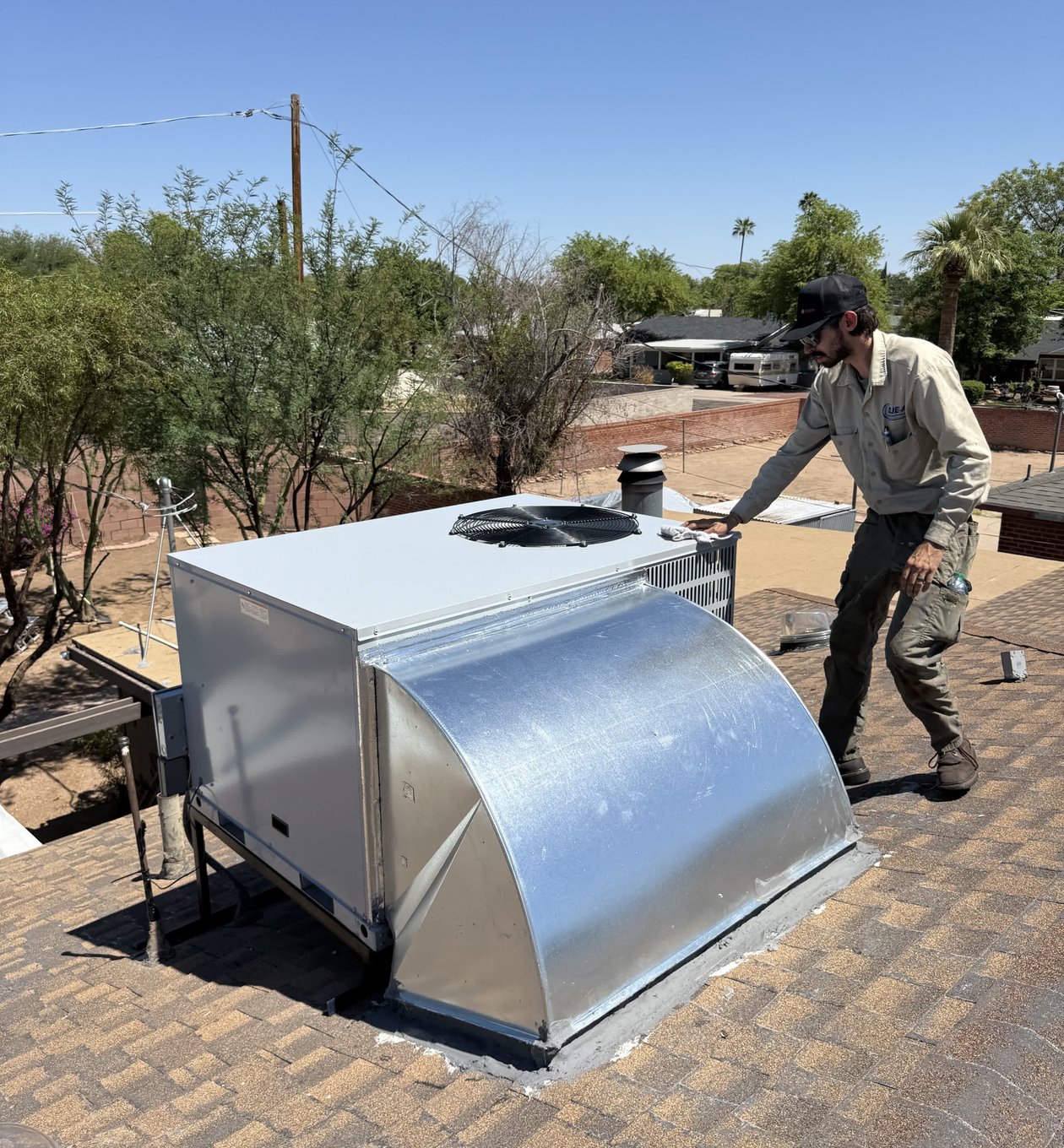
Failed Capacitors and Contactors: The run capacitor is one of the cheapest parts on the unit and by far the most common reason a Mesa air conditioner stops cooling. Heat shortens its life, and a capacitor that would last years in a mild climate gets cooked sitting on a Mesa rooftop. Contactors are close behind: the points pit, then weld, and the compressor either will not start or will not stop.
Condenser Coils Packed With Dust: A condenser rejects heat through its coil, and desert dust blinds it. Units near an alley, a dirt lot or a granite yard pick up a felt of dust that no garden hose will move. The system keeps running, draws more amps, cools less, and eventually trips on high head pressure.
Refrigerant Leaks and R-22 Systems: Refrigerant is not a consumable. If it is low, it leaked. That matters more in Mesa than in a newer city because so much of the surviving equipment here still runs R-22, and the EPA banned production and import of R-22 on January 1, 2020. Everything still in circulation is recycled or stockpiled. We find the leak first and give you the honest repair against replacement comparison.
Blocked Condensate Drains: Algae and dust plug the drain line, water backs up in the pan, and the float switch shuts the system down on purpose. Homeowners read that as a dead air conditioner. On older Mesa homes with the air handler in the attic, it is also the failure that does real ceiling damage if it is ignored.
Systems That Cannot Keep Up Past 110 Degrees: An air conditioner is engineered to pull indoor temperature a set number of degrees below outdoor, not to hit whatever number you dial in. A slightly degraded system limps through April and quits keeping up in July. In an older Mesa home that is often a combination problem: tired equipment, a marginal charge and a duct system that was never going to deliver on a 110 degree afternoon.
Undersized Returns and Tired Ductwork: This is the Mesa-specific one. In homes built through the 1970s and 1980s we routinely find a single undersized return, flex duct that has sagged or torn open in a blistering attic, and insulation that settled twenty years ago. Replace the condenser and leave that alone and you have bought an expensive way to cool the attic. We look at the delivery side, not just the box outside.

A Queen Creek Shop That Works Mesa Every Day
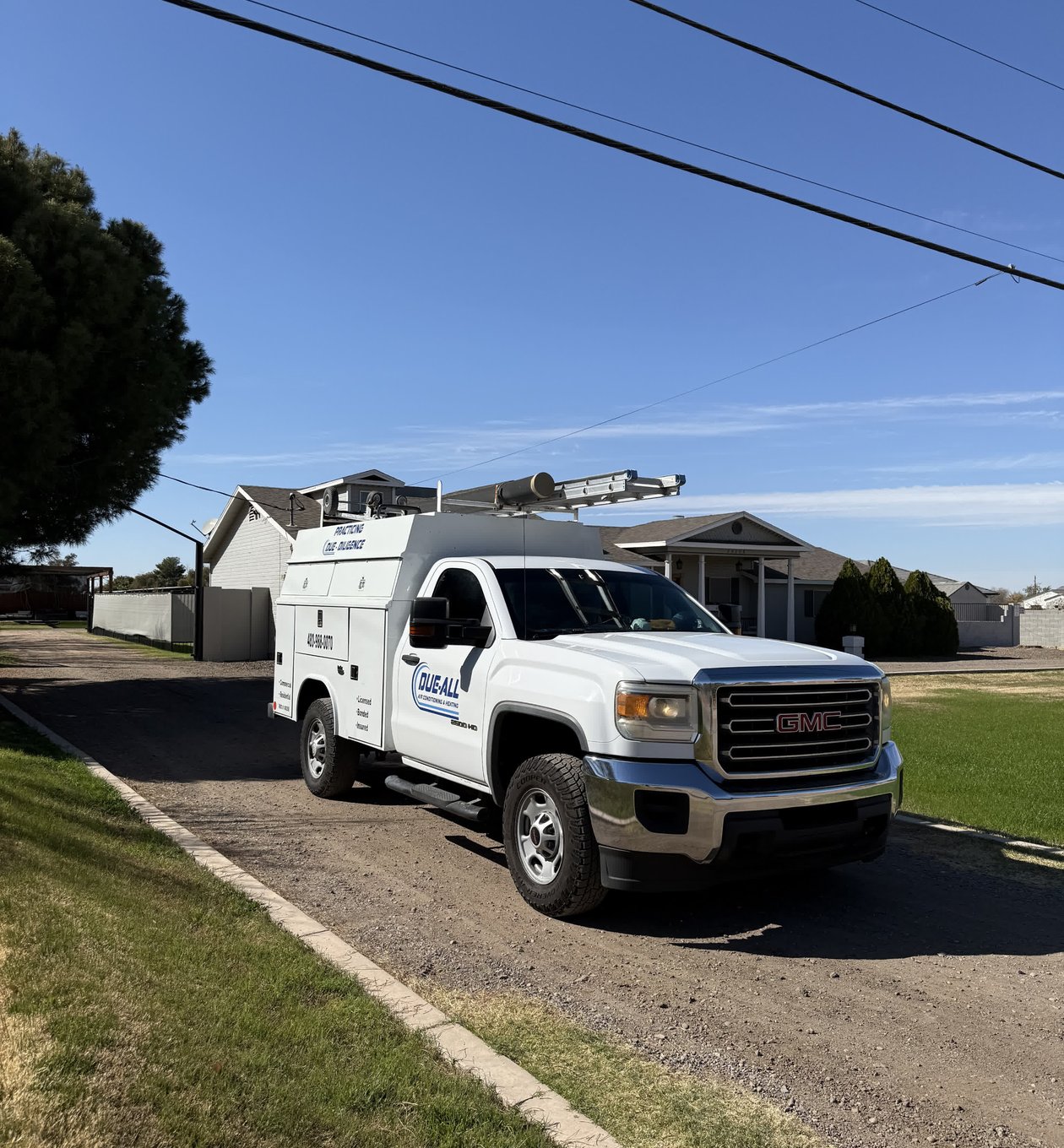
We are not a call center routing your job to whoever is nearest. Due-All runs out of Queen Creek, one town south, and Mesa has been part of our daily map since 1989.
Close Enough to Matter: Our shop is on Mandarin Drive in Queen Creek. Ellsworth Road runs straight north from here into south Mesa, and State Route 24 feeds the same corridor, so Eastmark, the Gateway area and the whole southeast side of the city are close work for us. Falcon Field and the far northeast are a longer run and we still make it.
Licensed, Bonded and Insured Since 1989: Arizona ROC #140358, accredited with the Better Business Bureau since 2001 with an A+ rating. Thirty-plus years in this valley means we have already seen whatever brand and vintage is on your Mesa roof, including the ones the manufacturer stopped supporting a decade ago.
We Know Mesa's Utility Map: Mesa is unusual. The city has run its own natural gas utility since 1917, serving over 80,000 customers across roughly 90 square miles, and it runs its own electric utility over about 5.5 square miles around downtown. Elsewhere you are on Southwest Gas, SRP or APS, and some Mesa homes have no gas line at all. That decides whether a heat pump or a gas furnace is the right replacement, and it changes street by street.
Repair or Replace, Told Straight: On older Mesa equipment that question comes up constantly, and it is where homeowners get taken. We will fix a fifteen year old unit if fixing it is the right call, and say so plainly when it is not. You get the diagnosis, the repair cost and the alternative, then you decide. No pressure and no manufactured emergency.
AC Repair Questions Mesa Homeowners Actually Ask
Because the equipment is older and so is everything around it. More than half of Mesa's housing units went up before 1990, and that shows up in far more than the air conditioner. Older homes tend to have smaller return openings, flex duct that has sagged or torn in the attic, and insulation that settled long ago. The air conditioner is not just older, it is fighting the building. Fixing the system without looking at the duct and return side usually just buys you one more hot summer.
We can, but you should know what you are buying. The EPA banned production and import of R-22 on January 1, 2020, so every pound still in circulation is recycled or stockpiled, and the cost reflects that. More to the point, a system that needs refrigerant has a leak, because refrigerant is not a consumable. We will locate the leak and give you the real repair cost against what a replacement looks like. On a twenty year old Mesa unit that comparison often favors replacement, but we will show you the reasoning instead of assuming.
Possibly, and possibly not. An air conditioner is sized to pull indoor temperature a set number of degrees below outdoor, not to hit any number you ask for. Past 110 degrees outside, a system that is even slightly degraded stops keeping up. The usual culprits we find in Mesa are a condenser coil packed with dust, a low charge from a slow leak, a filter nobody has changed since spring, or a blower wheel loaded with grime. Each one costs you capacity. We measure the actual temperature split at the equipment rather than guessing from the thermostat.
All of it. We work Mesa's standard ZIP codes: 85201, 85202, 85203, 85204, 85205, 85206, 85207, 85208, 85209, 85210, 85212, 85213 and 85215. That runs from the older west side around Dobson Ranch and downtown Main Street, east through Superstition Springs and Leisure World, north to Las Sendas and Falcon Field, and southeast to Eastmark and the Gateway corridor. Our shop is in Queen Creek and Ellsworth Road runs straight north into south Mesa, so the southeast side is close work. Call us and we will confirm scheduling for your address.
It depends partly on who supplies your gas, and in Mesa that is a genuine question. The City of Mesa has run its own natural gas utility since 1917 and serves over 80,000 customers across roughly 90 square miles, while other parts of town are on Southwest Gas and some homes have no gas line at all. Electric service is split too, between the City of Mesa's own utility around downtown, SRP and APS. We check what is actually at your house before recommending equipment, because the right answer changes street by street.
In rough order of how often we see it: run capacitors, the cheapest part on the unit and the most common no-cool call; contactors that have pitted and welded shut; condenser coils blinded by dust so the system cannot reject heat; condensate drains plugged with algae, which trips the float switch and shuts things down on purpose; and refrigerant leaks at the evaporator or the line set. Desert heat makes all five worse. A capacitor that would last years in a mild climate gets cooked on a Mesa rooftop.
Where We Work in Mesa
Mesa splits east and west at Center Street, and the two halves do not hand us the same problems. West Mesa carries the older stock. Dobson Ranch, the city's first planned community, was built between 1973 and 1999 and holds around 5,000 homes, and the downtown core around Main Street and the Mesa Arts Center is older still. East Mesa is a patchwork by decade. Leisure World, the gated 55+ community, was founded in 1972 and finished out at 2,664 homes in 1994. Las Sendas sits up against the Tonto National Forest with roughly 3,500 homes on much newer equipment. Then you drop southeast to Eastmark, whose first residential phase opened in 2013, where the failures we see are installation related rather than age related. We work all of it, plus the commercial and multi-family properties around Superstition Springs Center, Mesa Riverview, Falcon Field and the Gateway corridor.
Timing matters here more than most people expect. NOAA's 1991 to 2020 climate normals for the Phoenix area put May through September at roughly 82 percent of the entire year's cooling load, with an annual normal of 111 days at or above 100 degrees. A weak system will coast through April. It will not coast through July. The cheapest time to find a failing capacitor, a blocked drain or a leaking coil is in the spring, before the part has to go in on a rooftop in the middle of a July afternoon. If your Mesa system struggled last summer, that is the system telling you what it plans to do this one.
Due-All Air Conditioning & Heating has served Mesa and the rest of the East Valley since 1989, on residential, apartment and commercial work. Arizona ROC #140358, licensed, bonded and insured. Call (480) 988-0070 or send us the form above and tell us what your system is doing.